Tag: enterprise 2.0

Blogs for customers, not companies

Blogs are written for all sorts of reasons. Most are a labour of love viewed by a small band of readers. Corporate blogs on the other hand can and should have a much broader reach. They can be an important part of supporting an organization’s brand.

So what makes a successful corporate blog?

First and foremost is the realization that a blog is for the customer’s benefit – not for the company’s. It’s important to remember readers will only come back if there is value for them. That’s right value for them. Not value for the company. Readers don’t care if you are providing a nice, efficient press release site.

Rick Burnes reminds us of the real reason for corporate blogs in a posting at ZDNet.

Blogs for Customers, Not About Companies

If you look closely at the search results you pull up every day (and even some of the Alltop corporate blogs), you’ll see that an alternative model of corporate blogging is beginning to emerge. Instead of writing about themselves, companies are following the lead of the other company blog in the Technorati Top 100 — Signal vs. Noise. They’re beginning to create content that’s not about their business, but that appeals to their buyer personas.

Whole Foods is going beyond their blog and publishing recipes. American Express is publishing small-business advice. Indium Corporation is writing about thermal interface materials.

In each of these cases, the company is attracting a broad audience by focusing on content that is interesting to the demographic it serves rather than content about the products it sells.

Every company that is considering starting a corporate blog should spend some thinking about how this effort can support their brand. Otherwise publishing the blog could be wasted effort.

Work is an event, not a place

Our world is changing. Cost pressures, low employee engagement scores and green initiatives are on the radar of most organizations. It’s time for enterprises to take a serious look at teleworking.

This podcast from Podtech.net and sponsored by Verizon Business provides a strong case to include a teleworking intiative in your 2009 planning. Some key points:

  • to be effective, teleworking needs to be supported right from the top of the organization
  • productivity and engagement scores can go up when employees are given the option to telework
  • IT needs to step up and deliver reliable, secure and cost effective solutions during 2009
  • technologies such as collaboration, unified communications and mobile access need to be part of the mix
  • cost savings are available from implementing a hoteling workstation environment
  • reduction in carbon footprint and congestion show corporate responsibility to staff and customers
  • HR needs to provide training to managers who will have staff working from remote locations

Source: Podtech.net

Sponsored by Verizon

5 reasons IT is soooo slowwww

The speed at which IT delivers projects is often discussed over coffee or lunch. Although staff shortages, other resources and complexity are often the cause, there are other underlying aspects that can slow down IT projects to snail’s (or turtle’s) pace.

5-reasons-it-is-so-slow

So slow

ZDNET reports on the Computerworld article “The 5 reasons IT can’t speed things up”. I think the first two are way overdue in being addressed.

A focus on big projects. In every case, the whole structure of the IT organization — from project offices to approval processes — is geared for large projects that last a year or longer. The projects are strictly linear, with business analysts interacting with architecture to produce reference solutions, then development experts converting that into designs, and then specifications being laid down. All this is good for getting a big effort right, but these steps slow down the work.

Hostility toward new ways of doing things. These IT organizations won’t invest in and experiment with new tools, approaches and methods until there is a project “worthy” of them. Meanwhile, no business client will take a chance on anything new. The result is that yesterday’s languages, tools and methods remain today’s — and likely tomorrow’s.

Silence rather than dialogue on IT investments. When business people are left in the dark about IT’s existing portfolio, they can only wonder: Are the existing pieces expensive to maintain and test? Is the company losing technical quality through skills attrition or lack of investment by vendors? Is it suffering declining functionality as the work processes evolve and the software doesn’t? Without portfolio feedback, the business can’t judge whether to extend what it owns a little longer or to start again for the next decade. More often than not, the business defers to IT — and IT defers to what it already knows.

The business side’s commitment level. Not all the problems are in IT. In every one of these companies, the business does not make IT tech projects a priority. Decision-makers don’t come to meetings, and key issues aren’t worked out early. Far too often, core questions — “What is a superior customer experience?” or “What is a premier supplier?” — aren’t asked until late in the game.

At project’s end, the business won’t participate in testing or invest in deployment support. That’s a governance breakdown. Successful IT projects are a partnership, but too often the business side fails to do its part.

Corporate style. Corporate behavior influences what you can do. If your performance evaluation system is too rigid, or if you are required to plan (and then execute according to that plan) with nothing held back for change, your speed will be limited. Here, IT can push against the limits, but it’s hard to go any great distance past them.

Computerworld column by: Bruce Stewart

Wiki collaboration leads to happiness

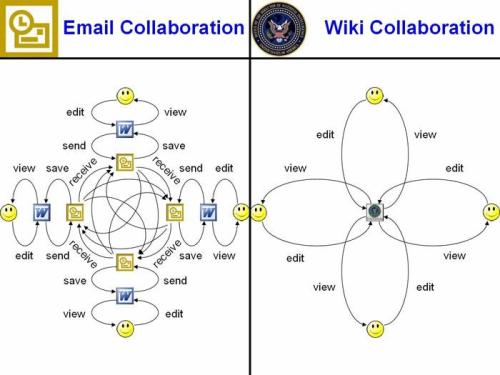
The power of wiki collaboration can be summed up in this Wikinomics graphics, originally created by Chris Rasmussen at US National Geospatial Intelligence Agency. For large enterprises caught in the mire of email and multiple copies of documents a wiki can be a godsend.

So why is it so difficult change behaviour. Take out wiki and replace with SharePoint and you still have will the tendancy to use email and separate documents.

Collaboration - Email vs. Wiki

Collaboration - Email vs. Wiki

From : Wikinomics Blog